
Why a two-level home often beats a three-storey townhouse
Why new townhouses went to three storeys, what that costs you day to day, and why a two-level home suits more buyers than the market builds for.
The short answer
- The trade
- Three storeys buys floor area on a small site, two levels buys liveability
- Why three took over
- Land cost and density rules, not buyer demand
- The daily cost
- Two flights between the bedroom and the kitchen, every day
- Who feels it most
- Anyone with young children, sore knees, or a plan to stay put
- What two levels gives back
- Fewer stairs, a usable ground floor, and a home that ages with you
- The counterpoint
- Three storeys can mean a better location for the same money
Walk through almost any new townhouse development in Auckland and you'll see the same shape: garage and entry on the ground, living in the middle, bedrooms up top. Three storeys has become so standard that buyers assume it's simply how townhouses are.
It isn't. Three storeys is the answer to a developer's problem, not the buyer's. I work on the developer's side of that decision, running feasibility and pricing at Heartland, a company that has been making it for thirty-five years. So let me lay the trade out honestly: why the shape became standard, what it costs to live in, and who a two-level home actually suits.
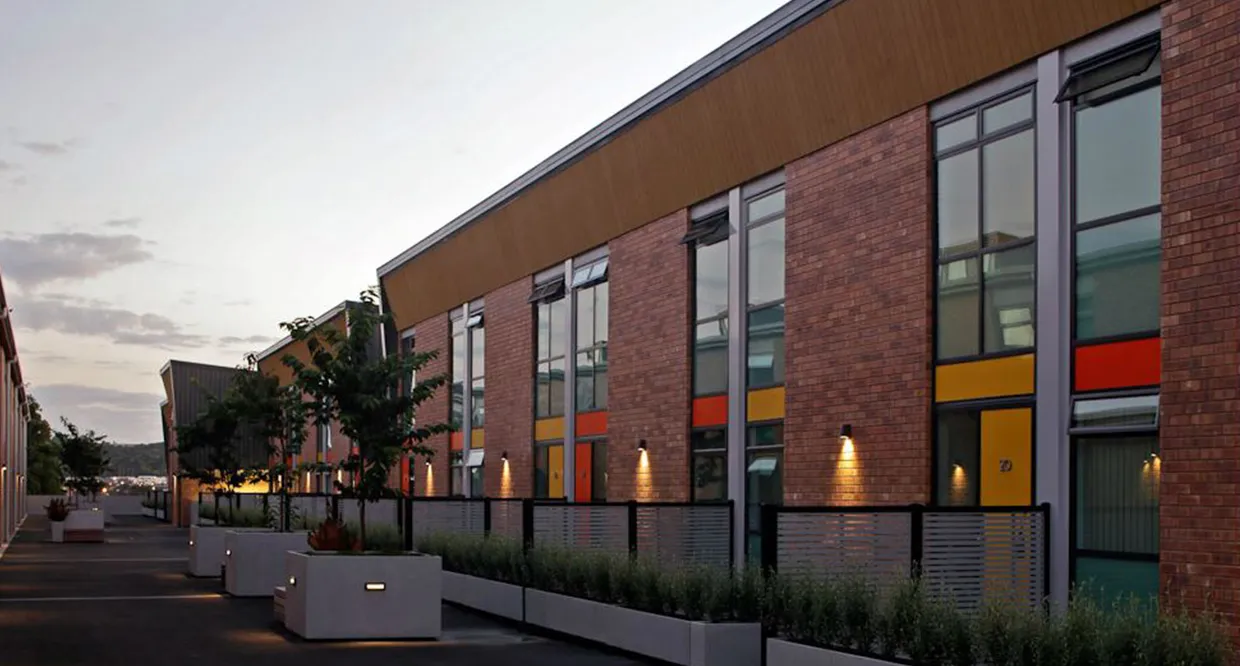
Two levels, front doors on the street: The Reserve, Flat Bush.
Why are so many new townhouses three storeys?
Land near the city is expensive, and a developer recovers that cost by fitting as many sellable homes on a site as the rules and the geometry allow. Going up is the cheapest way to add floor area without buying more land. A third storey turns the same footprint into a bigger home, or lets four dwellings stand where three would otherwise fit.
The driver is density for feasibility. We call it spreadsheet developing: a home that works on paper before anyone has tested how it lives. On yield per square metre of land, three storeys usually wins, and there's a borrowed logic running underneath, that other cities stack townhouses three storeys high, so Auckland can too. It's a perfectly rational answer to the question the developer is asking. The trouble is the buyer is asking a different question: what is this like to live in for twenty years?
What are the downsides of a three-storey townhouse?
The trade-offs don't show up at the open home. They show up afterwards, in the everyday.
Three levels means two flights of stairs between the things you use most. Groceries, a load of washing, the bins: each becomes a stair trip. That's manageable at forty and a real problem at seventy. Living on the middle floor means the kitchen and lounge sit between neighbours' floors, and the outdoor space, where there is one, is a level away from where you actually live. And a three-storey home assumes you'll always take stairs easily. The day that stops being true, the home stops working, and there's usually no level alternative inside it.
None of this makes three storeys wrong. For a young household chasing maximum space near the city on a budget, the trade can be worth it. But it is a trade, and it's rarely presented as one.
What are the advantages of a two-level home?
A two-level home designed deliberately, rather than squeezed, changes the daily experience. Living, kitchen and the main outdoor space sit together on one level with a real, flat connection to a courtyard or garden. Bedrooms sit one flight up, not two.
The best version goes further and puts a master bedroom, a bathroom, the kitchen and the living all on the entry level, with the extra rooms upstairs for family and guests. You can live entirely on the ground floor and use the second only when you want it, and done properly there's room for two master-sized bedrooms, one on each level, which keeps options open as the household changes. The detail matters as much as the layout: wider stairs with generous flat landings rather than steep drops, level-entry showers with low or no lips, and provision built in early, like lift-ready cupboards for future transformation, so the home can adapt rather than evict you. That's how we set our own design rules at Heartland: a master suite on the entry level wherever the site allows, stair counts kept honest, no four-metre-wide floor plates that force everything vertical. We design homes to be lived in, because that's who we sell to.
The buyer the market forgot
There's a specific person the Auckland market under-serves: the downsizer. Usually 55-plus, leaving a big family house and a section they no longer want to maintain, nowhere near ready for a retirement village, and not willing to give up their suburb.
What that buyer wants is consistent: low-maintenance, lock-up-and-leave, near shops and green space, and ideally liveable on one level. A smaller home that's also a better one. What the market hands them is three-storey townhouses built to a yield formula, which solve none of it. The shortage of genuine two-level and single-level stock in established suburbs is a real gap in the market, and a suburb like Epsom is exactly where that buyer wants to land. One of the few genuinely single-level homes we've built there, a top-floor penthouse at the Logan, is on the market now.
The honest counterpoints
Two levels usually means a larger footprint per home, so on expensive land it means fewer homes and a higher price for each one. You pay something for the lower-rise form. That's the true reason it's rare, and why it tends to come from developers building for the owner-occupier rather than for maximum unit count.
Not every site allows it either. Planning rules, dimensions and neighbours sometimes make three storeys the only way to build at all, and where that's true, good design is about making the stairs and stacking work as well as they can rather than pretending the trade-off away. And for some households, the young and mobile especially, the extra floor is the right call.
For people planning to stay, two levels usually wins, and almost nobody is building it. We think that's the opportunity, and it shapes what we choose to build next.
Heartland designs lower-rise homes for inner Auckland with the person who'll live in them in mind. If you'd like to be the first to hear about our next development, register your interest.
Sources
- Opes Partners: 3-bedroom townhouse review (townhouse form and trade-offs)
Questions people ask about two-level vs three-storey homes
Why do most new townhouses in Auckland have three storeys?+
Land near the city is expensive, and going up is the cheapest way to add floor area without buying more of it. A third storey turns the same footprint into a bigger home, or lets four dwellings stand where three would otherwise fit. It solves the developer's yield problem, not the buyer's daily experience.
What are the downsides of living in a three-storey townhouse?+
Three levels means two flights of stairs between the things you use most: groceries, washing, the bins. That's manageable at forty and a real problem at seventy. Living on the middle floor also sandwiches the kitchen and lounge between neighbours' floors, with outdoor space a level away from where you live.
Who does a two-level home suit best?+
Downsizers wanting low-maintenance, lock-up-and-leave living, and anyone planning to stay in a home long-term rather than trade up. A well-designed two-level home can put the master bedroom, bathroom, kitchen and living all on the entry level, so the ground floor works on its own.
Are two-level homes more expensive than three-storey townhouses?+
Usually, on the same land. Two levels means a larger footprint per home, so on expensive land it means fewer homes and a higher price for each one. That's the honest reason genuine two-level stock is rare, and why it tends to come from developers building for the owner-occupier rather than for maximum unit count.
Is a three-storey townhouse ever the right choice?+
Yes. For a young, mobile household chasing maximum space near the city on a budget, the trade can be worth it, and on some sites planning rules and dimensions make three storeys the only way to build at all.
About the author

James is Heartland’s development manager and the second generation of the family in the business, working across feasibility, consenting, consultant engagement and buyer research. He came to development through construction, and holds degrees in property and commerce from the University of Auckland.