
Body corporate fees in NZ, explained by a developer
What body corporate fees cover in NZ, what Auckland apartments actually pay, who sets the first budget on a new build, and how to check a levy before you buy.
The short answer
- What it is
- Each owner's share of running the building: insurance, maintenance, admin, and the long-term fund
- Typical Auckland range
- Most apartments sit around $4,000 to $6,000 a year. The full spread runs $2,500 to $8,500 and beyond
- What it is not
- Council rates. You pay those separately, exactly as a house owner does
- Who pays
- The owner, not the tenant. Landlords price it into rent, the occupier never sees the invoice
- Who sets the first number
- On a new building, the developer sets the first year's budget, which is why it deserves scrutiny
- The real test
- Not how low the levy is, but whether the Long Term Maintenance Plan behind it is funded
Body corporate fees are each apartment owner's share of running the building: the insurance, the maintenance of everything shared, the administration, and the savings plan for future big-ticket work. In Auckland most apartments sit somewhere around $4,000 to $6,000 a year, and the full spread runs from about $2,500 for a simple walk-up to $8,500 and beyond for buildings with lifts, pools and concierge services. Whether your number is good value or a warning sign depends entirely on what sits behind it.
I sit on the other side of this: Heartland has built and sold apartment buildings, and on a new building it is the developer who establishes the body corporate and sets its very first budget. I have done it, line by line, quote by quote. So I know exactly how that number gets made, how it can be made to look artificially attractive, and what I would check before relying on one.
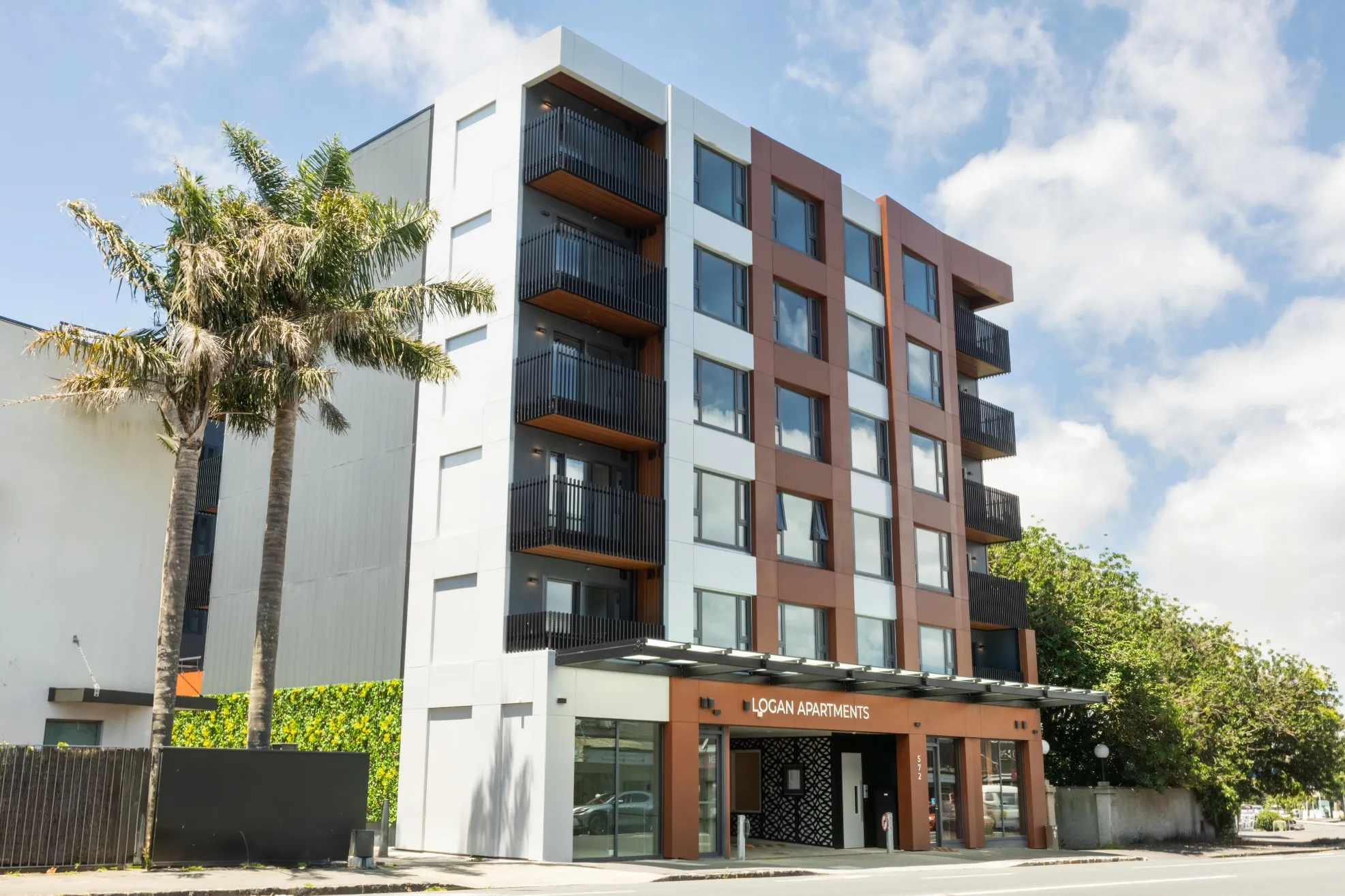
One building, 41 owners, one shared budget: the Logan at Greenwoods Corner.
What is a body corporate, and what is the fee?
Buy an apartment or a unit-titled townhouse in New Zealand and you automatically become a member of the body corporate: the legal entity made up of every owner in the building. The Unit Titles Act 2010 governs it. The building's shared property, its roof, foyer, lifts, gardens and driveway, belongs to everyone, so its costs are met by everyone.
The body corporate fee, properly called a levy, is your share of those costs for the year. It is set from an actual budget approved at the annual general meeting, the yearly meeting of all owners, not plucked from the air. That is worth knowing because it means the levy is a number you can interrogate: there is a budget behind it, line by line, and you are entitled to read it before you buy.
How you pay it is the body corporate's to decide: quarterly, six-monthly, or one annual lump sum. At the Logan we invoice six-monthly. That softens the impact of a large one-off payment for owners while still holding enough in the account to pay the year's insurance premium upfront, rather than financing the premium through the insurer and paying extra for the convenience. Small mechanics like that are invisible in a listing and worth real money over a decade of ownership.
What do body corporate fees cover?
The typical budget has four parts. Insurance is the largest single line, and it is not close. The body corporate insures the whole building, which is why apartment owners carry only contents and liability cover rather than full house insurance. The second biggest line is typically management: a body corporate manager, and in larger buildings a building manager on top. Maintenance and operations covers the shared fabric: cleaning, gardens, lift servicing, exterior washes, repairs. Administration covers secretarial work, meetings and compliance, including the building warrant of fitness, the annual certificate confirming the building's safety systems have been inspected.
That management line is worth interrogating rather than accepting. Some buildings run with an active committee of owners instead of an employed building manager and save considerable money doing it. Some buildings really are too complicated for that. But no one will ever know the building better than the owners who live in it, and a body corporate that engages does the job well. The right answer depends on the building, not on what a management company would prefer to sell you.
The fourth part, the one that separates well-run buildings from cheap-looking ones, is the contribution to the long-term maintenance fund. The Long Term Maintenance Plan, usually shortened to LTMP, is a forward schedule of predictable big-ticket work: repainting, roof membrane, lift overhaul, exterior sealing. Since May 2024 the Unit Titles Act requires bodies corporate of ten or more units to hold a plan covering 30 years. The plan must state the building's current condition and how the work will be funded, and be reviewed at least every three years. Smaller bodies corporate still need a ten-year plan. The fund is the money being saved against that schedule. A building saving properly pays for its future in instalments. A building that is not saving pays for its future in special levies, which is the same money arriving as a crisis.
How much are body corporate fees in Auckland?
Market commentary puts the typical Auckland apartment at roughly $4,000 to $6,000 a year, and an average around $5,000 is commonly quoted for Auckland buildings. Both figures are consistent with what we see across the market. Small walk-up blocks with no lift can run cheaper. Buildings with lifts, pools, gyms and concierge services run higher, and buildings working through remedial issues can run far higher, past $10,000.
The spread is the point. The levy is not a tax at a set rate. It is a mirror held up to the building. Fewer shared services mean a smaller budget. More amenity means a bigger one. That is also why comparing two apartments on levy alone is meaningless: a $4,000 levy covering no lift and no long-term saving is worse value than a $6,500 levy covering a lift, full insurance and a properly funded plan.
You can read most of a building's levy from a walk-through, because every shared feature is a standing appointment with maintenance, insurance and cleaning. The telltale signs of a high levy:
- A pool. The single most expensive amenity per hour of actual use: heating, chemicals, compliance and constant upkeep.
- Extensive landscaping. Gardens are beautiful and never finished, someone is paid to keep them that way.
- Large common areas and shared lounges. Every square metre of shared interior is cleaned, heated, lit and insured all year.
- Viewing terraces and rooftop decks. Weather exposure plus membranes plus balustrades: high-cost surfaces with a safety compliance layer on top.
- Lifts, gyms and concierge. Each is a service contract that renews annually and never gets cheaper.
None of these are reasons not to buy. They are reasons the levy is what it is, and a buyer who wants the pool should want it properly maintained. The mistake is wanting the amenity and resenting its invoice.
When levies rise, insurance is usually the reason. Building insurance premiums have climbed hard in recent years, and because the premium is the budget's biggest line, a repricing flows almost directly into the levy. In our experience the increase itself is rarely the real problem, the communication is. An insurance jump lands badly when owners first hear about it as a number on an invoice. It lands fine when the committee explains what was quoted, what was negotiated and why the cover is what it is. In our experience the owners who skip the meetings are the same ones ringing about the invoice.
Do body corporate fees include council rates?
No, and this catches people moving from houses. Council rates are billed to each unit's owner separately, exactly as they were on the house. The levy covers the building's shared costs. Rates cover your council services. The same boundary applies to everything else that is exclusively yours: contents insurance, your own power, water and internet, and the maintenance of everything inside your unit all sit outside the levy.
When you budget for an apartment, the honest annual figure is levy plus rates plus your own utilities. When you compare that against a house, the comparison is against rates plus insurance plus every trade, repair and weekend the house was already costing you. Run it that way and the levy usually stops looking like a new cost and starts looking like the old costs, invoiced honestly, with the labour done by someone else.
How are body corporate fees calculated?
Two numbers decide what you personally pay: your share of the building, and what the building costs to run. Cheap body corporate fees are simply a small slice of a cheap-to-run building. Expensive ones are a large slice of an expensive one. Everything else is detail.
The share is your unit's ownership interest, what Australians call unit entitlement. It is fixed when the building is created: the licensed surveyor prepares the unit plan, and a registered valuer assigns each unit's interest from its value relative to the others. For most operating costs a utility interest derived from it does the day-to-day work. Larger, more valuable units carry a bigger share, so the penthouse contributes more than the one-bedroom two floors down. Because the split is fixed in the unit plan, it is knowable before you buy, and your solicitor can tell you exactly what fraction of any future budget is yours.
The running cost, meanwhile, is largely decided years before the first owner moves in, at the design table. Lift or walk-up, pool or no pool, basement type, cladding choice, how much landscaped common area there is to maintain: these are developer decisions, and they set the building's cost structure for its whole life. By the time the first annual general meeting votes on a budget, most of the levy was already locked in by the drawings.
One clarification for townhouse buyers, because the question comes up constantly: only unit-titled townhouses have a body corporate. A freehold townhouse has no levy at all, though many newer developments run a residents' society with a smaller annual fee for the shared driveway and landscaping. The title tells you which world you are in, and the difference matters more than the marketing does.
Who sets the fees on a brand-new building?
Almost nobody writes about this part, because almost nobody writing about body corporate fees has ever had to do it. On a new building there is no body corporate history and no annual general meeting (AGM) yet, so the first budget is prepared by the developer. Every levy quoted in the marketing of an off-the-plan apartment traces back to a spreadsheet someone like me built.
That budget can be built two ways. Built honestly, it prices real insurance quotes, realistic maintenance, professional management and a genuine first contribution to the long-term fund. Built for the brochure, it assumes the cheapest possible everything and defers the future entirely. The advertised levy looks attractive, and the real number arrives in year two, after settlement, as a nasty surprise at the first AGM. Nothing in the Act stops the second version. Disclosure rules mean the numbers must be shown, but not that they must be realistic.
So ask the question directly: who prepared the first budget, what insurance quote is it based on, and does it include a long-term maintenance contribution from year one? A developer who budgets honestly will answer in a sentence. When we established the body corporate at the Logan, we mapped out every cost of running the building, then collected competing quotes line by line. The goal was simple: a building that runs cost-competitively for the people who own it. We treated the budget as part of the product: the owners who settled are the same people we sold to, and a year-two levy shock is not something you get to apologise for.
A small example of what that cost mapping turns up, learned setting up the Logan's body corporate. A building using private rubbish collection can apply to Auckland Council to have the kerbside waste charges removed from every owner's rates. A small base charge for regional waste remains, but the double-up disappears. Not a fortune per owner per year, but free money, and it doubles as a diagnostic: a body corporate paying for private collection while its owners still carry the full council waste charge is a body corporate that has not fully mapped the costs of running its own building. Ask whether it has been done. The answer tells you about everything else in the budget.
The first budget is not the only thing a developer establishes. The first set of body corporate rules gets written at the same time, and that is where pets, BBQs, committees and the question of what a body corporate can actually tell you to do all live. It deserves its own page, and it has one: body corporate rules, who writes them and what they actually restrict.
When is a low levy a red flag?
A low levy is only good news when the building has little to run. Otherwise it usually means one of three things: services have been cut, the insurance figure is stale, or the long-term fund is not being fed. All three are deferrals, not savings. The money still gets spent, it just arrives later as a special levy, a one-off charge on top of normal levies, at whatever moment the deferred work stops being deferrable.
Older buildings deserve particular care here. The 30-year plan requirement is recent, and a body corporate that spent years procrastinating maintenance may have no serious plan at all, just costs pushed down the track and compounding as they went. A building with a thin maintenance plan and a proud record of low levies is not a bargain. It is a special levy with your name on it, waiting for a date.
The check is straightforward and your solicitor will do most of it. Read the pre-purchase disclosure statements, the last two years of annual general meeting (AGM) minutes, the budget, and the Long Term Maintenance Plan with its funding position. The minutes tell you what the owners are actually arguing about. The plan tells you whether the future is being saved for. Ten minutes with those documents tells you more about the real cost of the apartment than any levy figure in a listing.
The honest comparison
Body corporate fees are the most visible cost of apartment living and the most misread. The levy is not the price of having neighbours. It is the running cost of a building, disclosed. Houses carry the same costs, undisclosed, spread across insurance bills, tradesmen's invoices and lost Saturdays, which is why they feel cheaper right up until the roof needs doing. The apartments worth owning are not the ones with the lowest levy. They are the ones where the levy is telling the truth.
If you're weighing that decision in Epsom right now, everything this page tells you to check is checkable against a building we run ourselves. The top-floor penthouse at the Logan is on the market, in a body corporate whose first budget, rules and maintenance plan we established. Ask us for the levy, the minutes and the maintenance plan, and read them with this page open. A building with nothing to hide is the whole point of the exercise.
This is general information only. Have your own solicitor review the body corporate disclosure documents before you buy. If you'd like to hear when Heartland opens registrations on a new project, register your interest.
Sources
- New Zealand Legislation: Unit Titles Act 2010 (bodies corporate, levies, ownership interest, long-term maintenance plans)
- Unit Titles Services (official government service): Body corporate money and maintenance (levies, funds and maintenance obligations)
- Unit Titles Services: Ensuring adequate planning for maintenance (the strengthened long-term maintenance plan requirements from May 2024)
- Unit Titles Services: Short Guide to Unit Titles, May 2024 (plain-English official overview of unit title ownership)
- Settled.govt.nz: What is a body corporate? (unit titles, levies and the long-term maintenance fund)
- Trade Me Property: How much are body corp fees? (typical $4,000 to $6,000 annual range)
- Auckland Body Corporate: Body Corporate Fees (circa $5,000 Auckland average per unit)
- Auckland Council: Waste collection services for apartments and units (removing council waste charges from rates where a building uses private collection)
Questions people ask about body corporate fees
What do body corporate fees cover in New Zealand?+
The running costs of everything the owners share: building insurance, maintenance of common areas like lifts, foyers, gardens and the roof, management and administration, shared utilities, compliance costs, and contributions to the long-term maintenance fund that pays for future big-ticket work like repainting or replacing the roof membrane.
How much are body corporate fees in Auckland?+
Most Auckland apartments sit somewhere around $4,000 to $6,000 a year, with smaller walk-up buildings below that and buildings with lifts, pools, gyms or remedial issues above it, sometimes well above $10,000. The number is set at each building's annual general meeting from an actual budget, so two similar-looking apartments can carry very different levies.
Do body corporate fees include council rates?+
No. Council rates are charged to each unit's owner separately, exactly as they are for a house. A body corporate levy covers the shared costs of the building. Rates cover your property's share of council services. Budgeting for an apartment means allowing for both.
What is not included in body corporate fees?+
Council rates, your contents insurance, your own power, water and internet, and the maintenance of everything inside your unit. The levy covers the shared building. Everything that is exclusively yours remains exclusively your cost, which is the same split a house owner already lives with.
How often do you pay body corporate fees?+
The levy is set annually from the budget, but the payment schedule is the body corporate's to decide: quarterly, six-monthly or a single lump sum. At the Logan we invoice six-monthly, which softens the lump-sum impact while keeping enough cash in the account to pay the insurance premium upfront rather than financing it through the insurer and paying extra for the convenience.
Who pays body corporate fees, the owner or the tenant?+
The owner. Levies are an owner's obligation under the Unit Titles Act 2010. A landlord will usually factor the levy into the rent they need, but the tenant never receives the invoice and cannot be made liable for it.
How are body corporate fees calculated for each apartment?+
Two numbers set your levy: the building's total annual running cost, and your unit's share of it. The share is your ownership interest, fixed by a registered valuer from each unit's relative value when the licensed surveyor's unit plan is deposited. Larger and more valuable units carry a larger share, which is why the penthouse pays more than a one-bedroom in the same building.
What is the difference between strata title and body corporate?+
Strata title is the Australian term. New Zealand's equivalent is unit title ownership under the Unit Titles Act 2010, where all owners collectively form the body corporate. The mechanics are similar, the vocabulary is not: what Australians call strata fees or unit entitlement, New Zealand calls body corporate levies and ownership interest.
Who sets the body corporate fees on a brand-new building?+
The developer sets the first year's budget before the first annual general meeting. A developer confident in the building budgets it honestly. A developer trying to make the marketing look good can set the levy artificially low and leave owners to discover the real number in year two. Ask who prepared the first budget and what insurance quote it is based on.
What makes body corporate fees high?+
Shared amenity. Pools, extensive landscaping, large common areas, shared lounges, viewing terraces, lifts, gyms and concierge services: each one carries its own maintenance, insurance and cleaning bill, so the more a building shares, the higher its levy. Insurance premium rises are the other main driver. A high levy on a high-amenity building is the amenity's honest price, not a warning sign in itself.
Is a low body corporate fee a good sign?+
Not by itself. A low levy on paper can mean fewer services, an underfunded long-term maintenance plan, or an insurance figure that has not been tested against a real quote. A building that is charging too little today is usually storing up a special levy for later. Read the levy against what it covers and against the maintenance plan's funding position.
Do townhouses pay body corporate fees?+
Only unit-titled townhouses do. A townhouse on its own freehold title has no body corporate, though many newer developments use a residents' society with a smaller annual fee for shared driveways and landscaping. Check the title: unit title means a body corporate and a levy, freehold means neither, and the difference changes your annual costs.
What is a special levy?+
A one-off charge the body corporate raises on top of normal levies to cover costs the budget and the long-term fund cannot, such as unexpected remedial work. Well-run buildings with well-funded long-term maintenance plans rarely need them. Buildings that kept levies artificially low for years often do.
What happens if an owner does not pay their body corporate levy?+
The debt sits against the owner and the body corporate can recover it, ultimately through the courts, with interest and costs. Unpaid levies also surface in the pre-purchase disclosure documents, so a building with a levy arrears problem is visible to any buyer who reads them.
How do I check a building's body corporate before buying?+
Read the disclosure statements your solicitor obtains, the last two years of annual general meeting minutes, the budget, and the Long Term Maintenance Plan with its funding position. Since May 2024 the law requires bodies corporate of ten or more units to hold a 30-year plan including the building's current condition and how the work will be funded. The minutes tell you what the building is really arguing about, and the plan tells you whether tomorrow's costs are already being saved for or waiting to arrive as a special levy.
About the author

James is Heartland’s development manager and the second generation of the family in the business, working across feasibility, consenting, consultant engagement and buyer research. He came to development through construction, and holds degrees in property and commerce from the University of Auckland.
Related reading
- GuideApartment or house in Epsom?The decision this fee question usually sits inside.
- GuideBuying off the plans in New ZealandDeposits, sunset clauses, and the contract checks before you sign.
- GuideBody corporate rulesPets, BBQs, tenants and committees: the governance side of the same building.
- Case studyLogan Apartments, Greenwoods CornerThe building whose first body corporate budget we set.